18 min read
1.Physical AI Is Bringing the Question of the “Body” Back to the Forefront
Over the past decade, most major advances in artificial intelligence have taken place in the digital domain. Language, vision, and generative models have continuously improved machines’ ability to understand and generate information.
However, as AI begins to move from information systems into physical systems, the structure of the problem fundamentally changes.
An intelligent agent operating in the real world is no longer simply a function mapping inputs to outputs. It must continuously interact with the physical environment through a body, performing processes such as:
Contact
Grasping
Manipulation
Locomotion
Force application
Perception
Continuous interaction with the environment
In this context, the central challenge of Physical AI is no longer limited to model capability. It raises a more fundamental question:
What kind of body enables intelligence to effectively embed itself in the physical world?
In a robotic system, the model generates decisions, while the physical body determines how those decisions are translated into real-world behavior.
As foundation models become increasingly capable, hardware can no longer be viewed as merely an “executor.” It is becoming one of the defining factors that determine the capability boundaries of the system.
This is why morphology is returning to the center of robotics design.
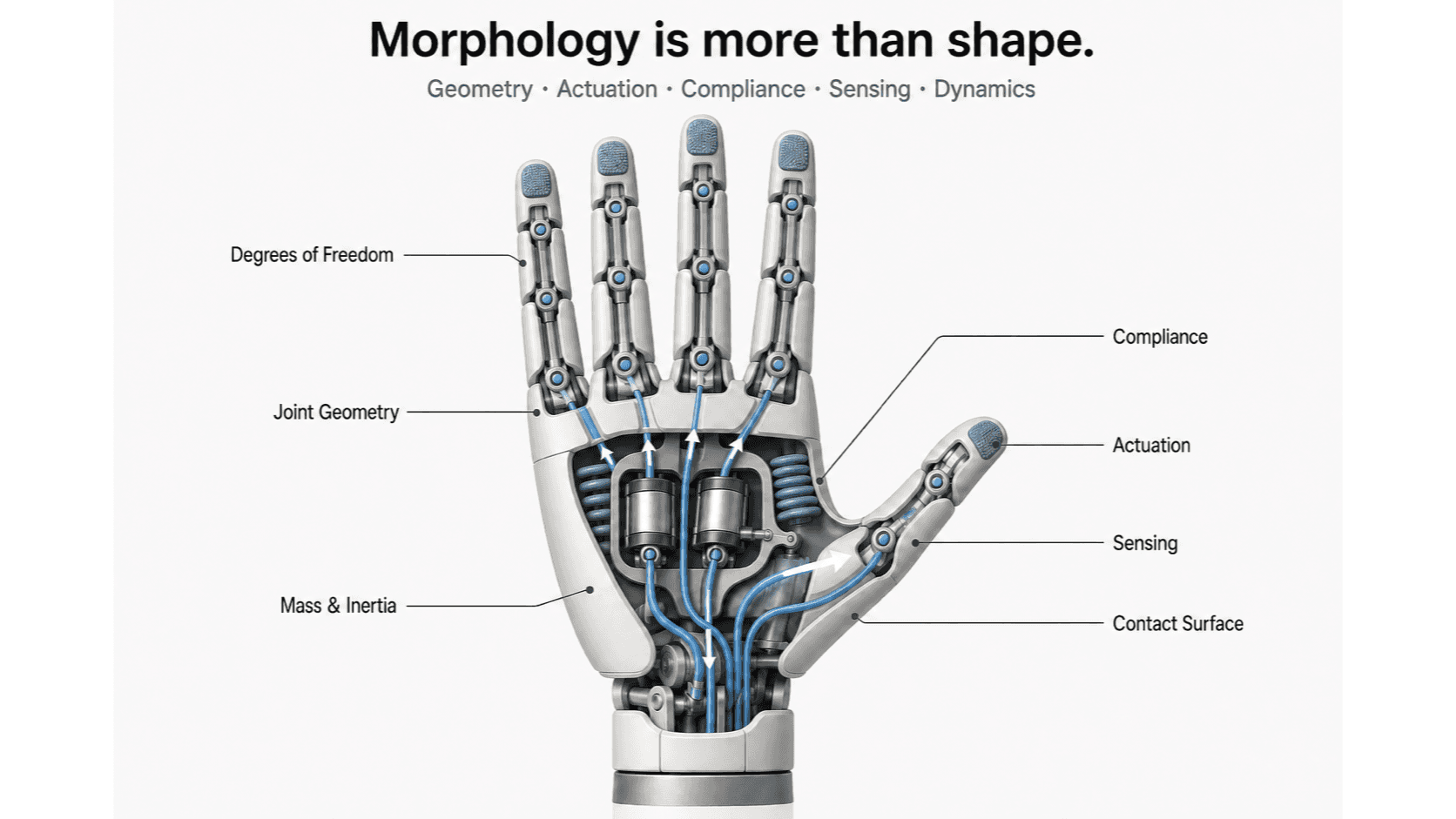
What Is Morphology?
In robotics, morphology is often understood simply as the physical form or shape of a robot. In reality, the concept extends far beyond appearance.
More precisely, morphology describes the overall physical organization of a robotic body, including:
The number and distribution of degrees of freedom
The geometry, orientation, and range of motion of joints
The proportions and scale relationships between body segments
Actuator placement
Force transmission paths
Mass and inertia distribution
Structural stiffness and compliance
Spatial distribution and coverage density of sensors
The geometry through which the robot contacts its environment
From a system perspective, morphology defines the robot’s physical reachability and interaction structure:
How it can move
How it can apply force
How it can perceive
How it can establish stable contact with the environment
For robot learning, this structure imposes constraints before learning even begins.
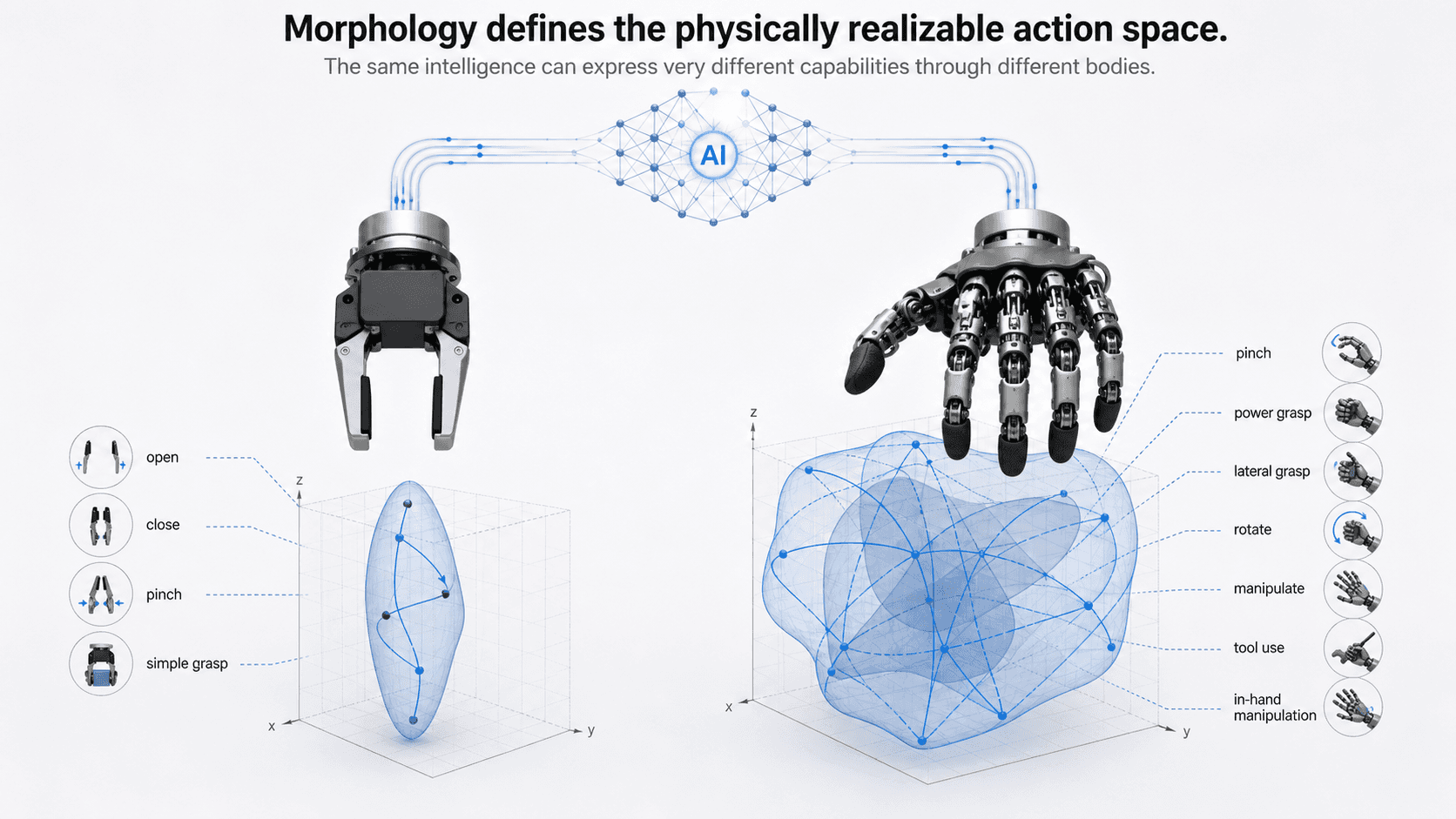
A two-finger gripper, for example, remains fundamentally constrained by its mechanical structure regardless of how powerful its policy model becomes. A system with multiple independently actuated fingers, an opposable thumb, compliant actuation, and dense tactile sensing can express an entirely different range of behaviors.
A more precise way to state this is:
Morphology defines the physical action space available to intelligence.
Before learning begins, the body has already constrained the space of physically feasible behaviors.
Morphology Is Not the Same as Visual Biomimicry
A common misconception in humanoid robotics is to equate being “human-like” with simply looking human.
The real value of human-like morphology does not lie in visual resemblance. It lies in the structural principles underlying the human body:
How degrees of freedom are distributed to create useful workspaces
How forces are transmitted and amplified across multiple joints
How compliance emerges naturally from the structure
How mass and inertia affect dynamic control
How sensing is distributed across the body
How the system adapts to unstructured environments
The essence of humanoid design is therefore not biological replication. It is the abstraction of a more fundamental question:
What structural principles allow the human body to perform complex physical interactions so efficiently?
This is where the real research value of humanoid robotics lies.
The Human World Is Built Around Human Morphology
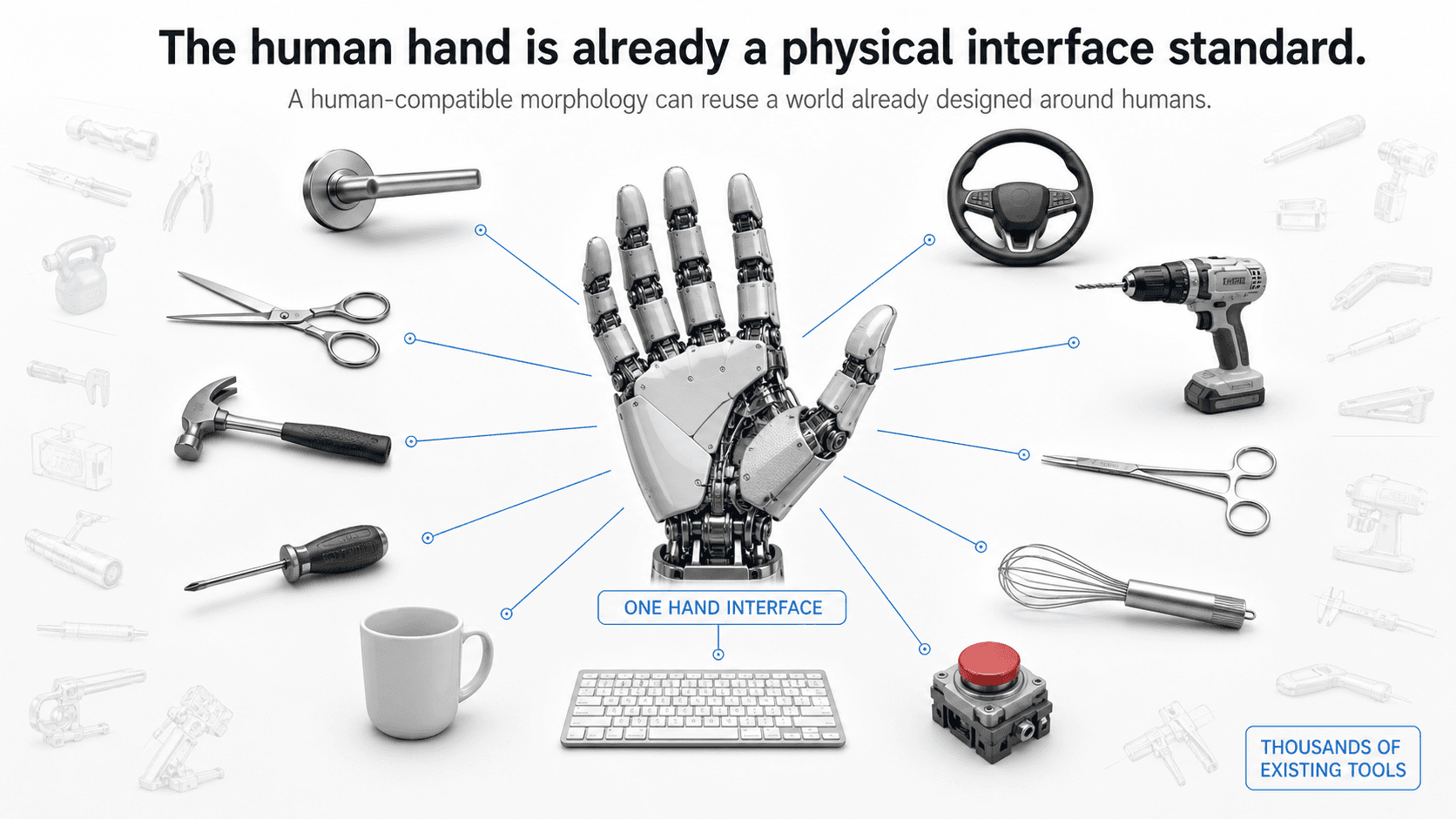
From an engineering perspective, the human environment is not a neutral space. It has evolved over time around the structure of the human body.
Examples include:
Door handles and knobs
Switches and control panels
Tools such as wrenches and screwdrivers
Keyboards and input devices
Kitchen and household appliances
Vehicle controls
Medical and industrial workstations
Clothing and everyday objects
These systems are designed around an implicit assumption: the operator has a human body.
One of the most important interfaces in this environment is the human hand, which has effectively become one of the most universal physical interaction standards in the real world.
The value of a humanoid hand, therefore, is not simply biological imitation. It is the ability to:
Reuse, as directly as possible, a physical world that has already been optimized around the human body.
From the perspective of system compatibility, human morphology can be understood as:
A structural compatibility layer for the human physical environment.
Why the Human Hand Is Worth Re-Engineering
The human hand is a highly complex, multi-degree-of-freedom mechanical system. Its engineering characteristics simultaneously approach extremes across several dimensions.
High Degrees of Freedom and Expressiveness
The hand offers an exceptionally rich range of motion, enabling grasping, pinching, rotating, sliding, and in-hand manipulation.
Force and Precision in the Same Structure
The same physical system can perform highly precise manipulation while also generating substantial grasping forces and carrying significant loads.
Low Distal Inertia
The separation between much of the actuation source and the distal joints allows the fingers to maintain relatively low mass and inertia, improving dynamic response.
Compliance
Tendons, muscles, and soft tissues collectively create complex passive and active compliance mechanisms.
Dense Sensing
Tactile sensing, proprioception, and vision form a multimodal closed-loop feedback system.
High Structural Integration
A large number of degrees of freedom, sensing capabilities, and actuation functions are integrated into a highly constrained physical volume.
The key value of the human hand therefore does not lie simply in having five fingers.
It lies in the question:
How can degrees of freedom, force output, compliance, and sensing be integrated simultaneously under extreme spatial constraints?
This is fundamentally a system-level engineering problem rather than a single mechanism design problem.
Tendon Drive Is More Than Biomimicry
Tendon-driven actuation is often categorized as a biomimetic design approach, but that explanation is incomplete.
From an engineering perspective, its core value lies in:
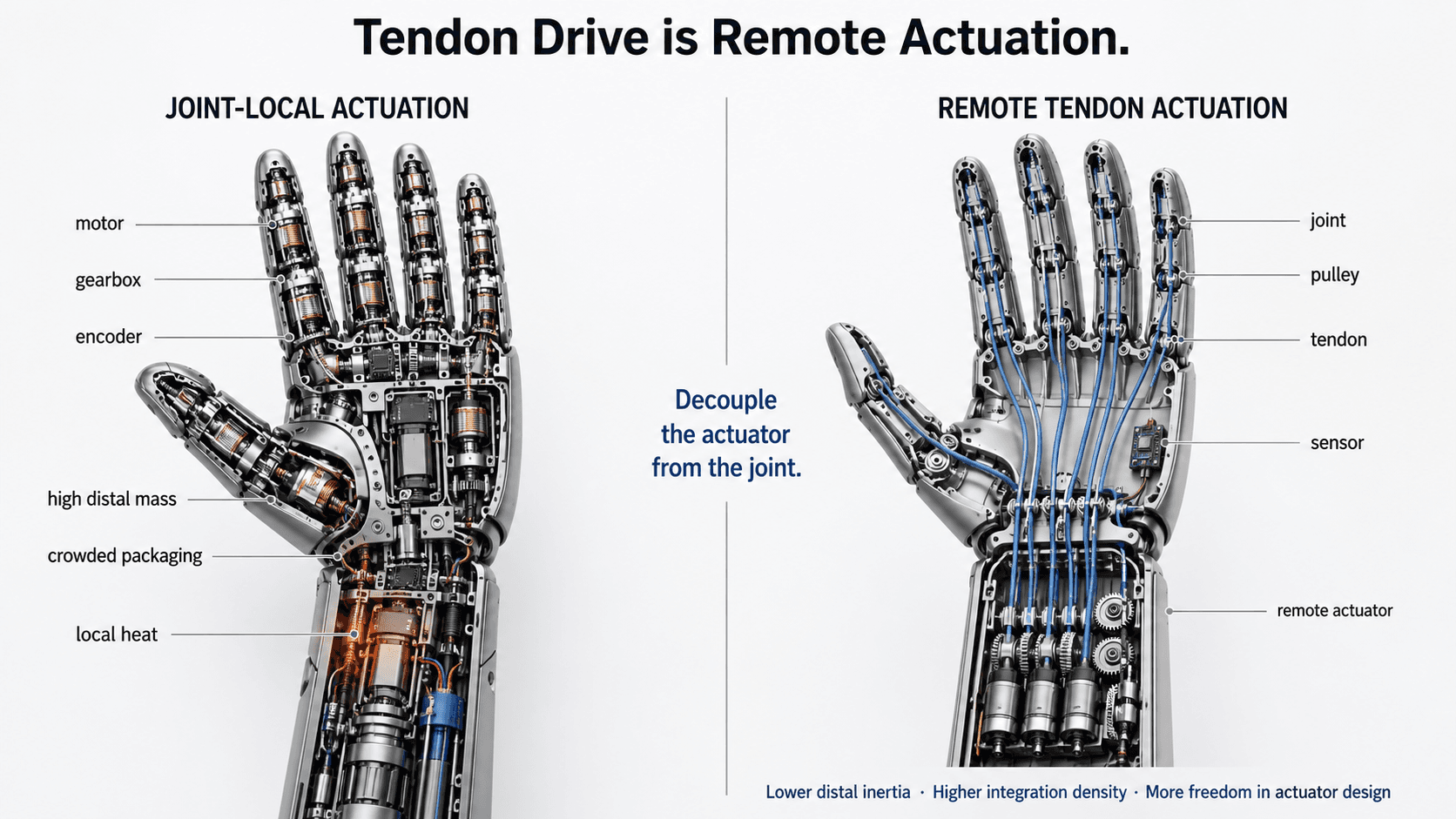
Spatially decoupling actuators from joints.
In other words, the source of mechanical power and the point at which that power is applied do not have to occupy the same location.
This principle is widely used outside biology, including in:
Aircraft control systems
Elevators and lifting systems
Bowden cable mechanisms
Bicycle transmission systems
Surgical robotic systems
The common principle is the use of a flexible transmission medium to transfer mechanical power remotely.
For high-degree-of-freedom dexterous hands, this architecture offers several important advantages:
Lower distal inertia
Greater freedom in structural layout
Reduced spatial constraints around joints
Higher system integration density
A more accurate description is therefore:
Tendon drive is a remote power-transmission architecture well suited to compact, high-degree-of-freedom robotic systems.
Its value comes from system-level engineering properties rather than biomimicry alone.
The Core Bottleneck of Traditional Tendon-Driven Systems: System Complexity
Despite their theoretical advantages, tendon-driven systems have historically struggled to become a dominant engineering solution.
The primary reason is the rapid increase in system complexity:
Complex tendon routing
Accumulated friction and hysteresis
Non-negligible elastic deformation
High maintenance cost for tensioning systems
Significant coupling across multiple degrees of freedom
Difficult assembly and calibration
Complex failure modes
Rapid growth in component count
The result is that higher dexterity often comes at the cost of increased engineering uncertainty.
The real question is therefore not simply:
Tendon Drive vs. Direct Drive
but rather:
Can actuation topology, mechanical structure, sensing, and control be designed together at the system level?
If tendon transmission is simply added on top of a conventional mechanical architecture, complexity can grow rapidly with the number of degrees of freedom and transmission paths.
From Joint Design to System Topology
Traditional robot design typically treats the joint as the fundamental unit:
Motor + Gearbox + Encoder → Joint → Robot
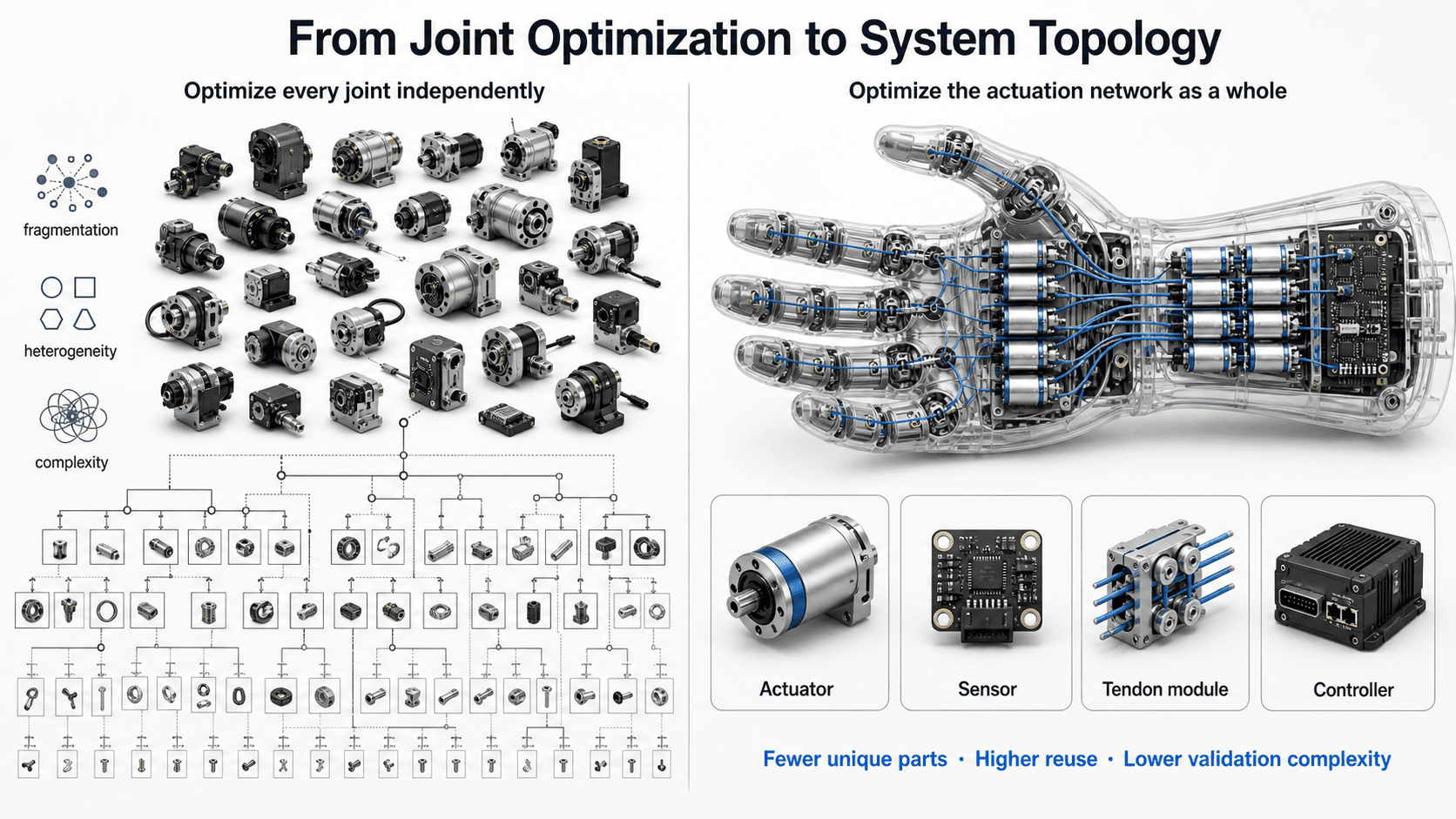
This paradigm works well for industrial manipulators, but begins to break down in high-degree-of-freedom dexterous hands.
Once a system reaches 20 or more degrees of freedom, independently designing every joint with:
Different motor specifications
Different reduction ratios
Different mechanism designs
Different transmission paths
Different control parameters
causes the robot to become an aggregation of heterogeneous subsystems rather than a coherent system.
The central problem therefore shifts to:
How should the actuation network be organized?
This is fundamentally a topology problem.
A well-designed topology must address:
How to minimize the number of actuation units
How transmission paths should be organized
How bidirectional force transmission should be achieved
How stable tension should be maintained
How coupling complexity can be reduced
How subsystem reuse can be increased
How unnecessary redundancy can be eliminated
At this level, topology directly affects:
Performance, cost, reliability, and manufacturability.
The Key to Scalable Dexterous Hands: Standardization and Reuse
Another major challenge in high-degree-of-freedom systems is the rapid increase in validation cost.
When every joint has a different load profile and architecture:
Each actuator requires independent development
Each subsystem requires independent lifetime validation
Each component requires separate supply-chain management
Each failure mode requires separate analysis
Engineering complexity can grow faster than the number of degrees of freedom itself.
A more scalable approach is to:
Design the structure so that multiple joints can share standardized subsystems.
The ideal engineering objective is:
Develop once. Validate once. Deploy many times.
Through load balancing and structural standardization, it becomes possible to increase reuse across:
Actuators
Sensors
Control electronics
Validation methodologies
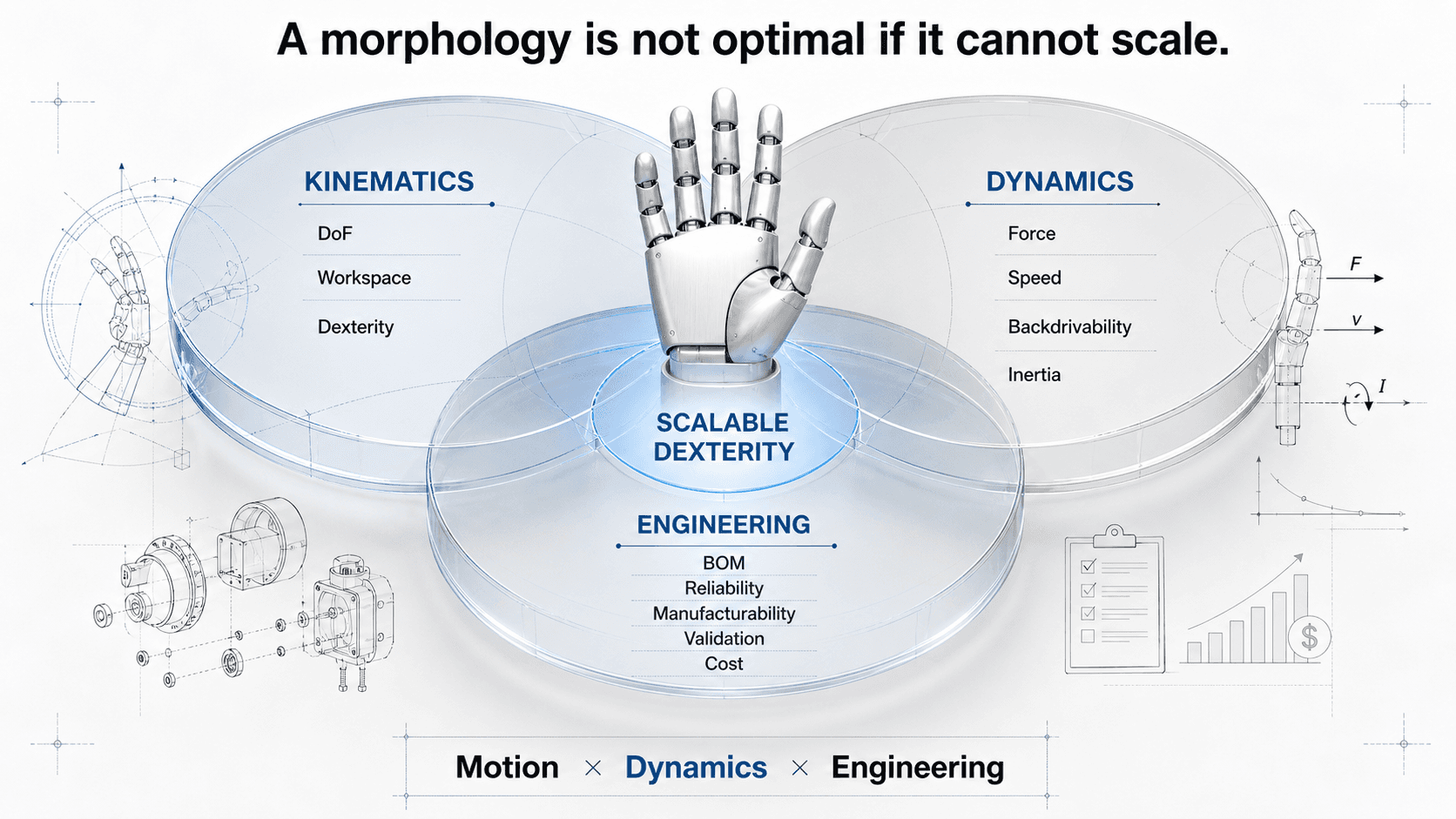
The value goes far beyond reducing BOM cost. It reduces the overall complexity of engineering the system.
This leads to a broader conclusion:
The quality of a morphology determines not only the capability ceiling of a robot, but also whether the system can scale as an engineered product.
Morphology as a Physical Prior
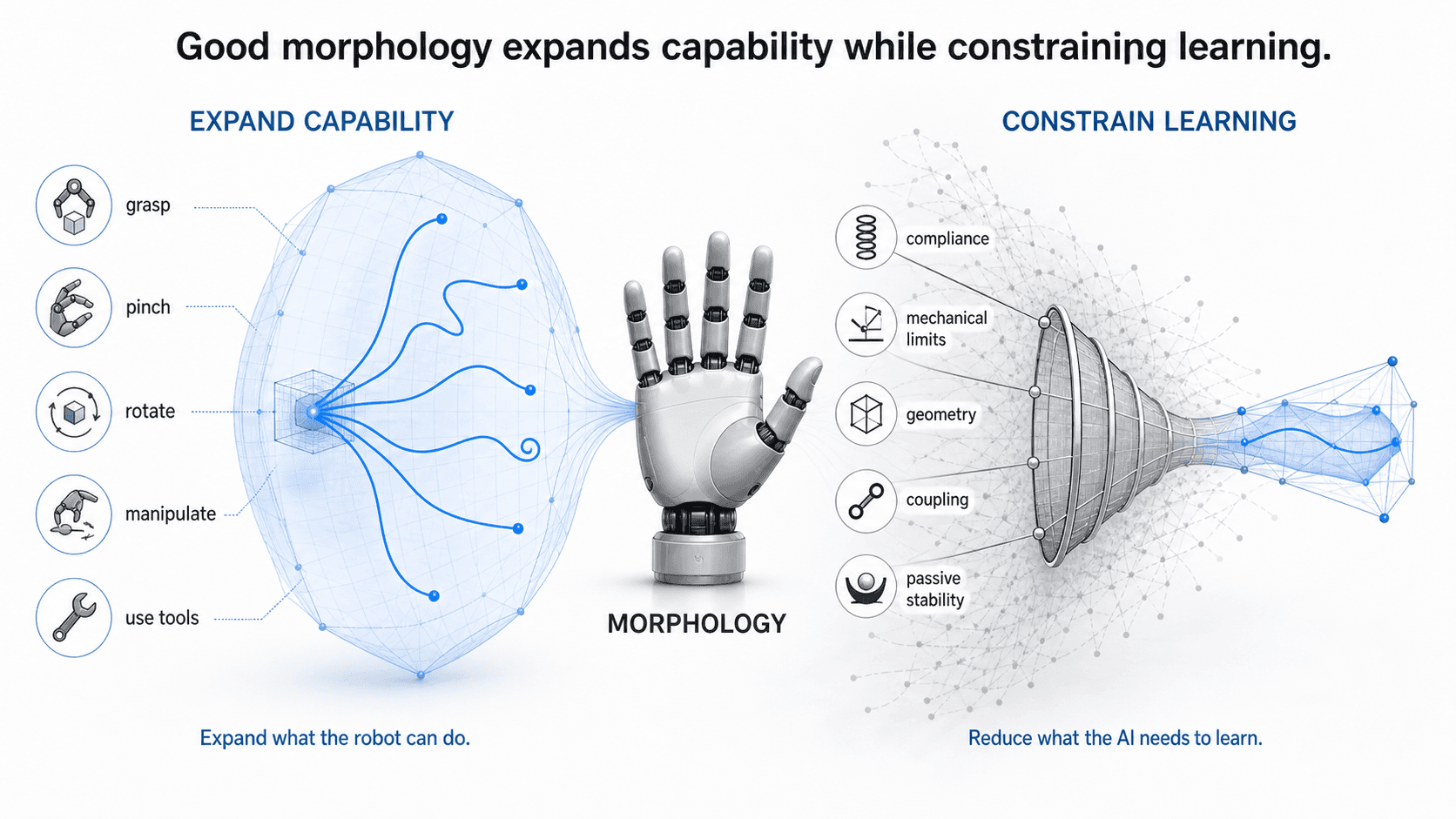
From the perspective of control and learning, a well-designed morphology can itself perform part of the “computation” required by the system.
For example:
Compliant structures reduce the need for exact contact modeling
Joint layouts can reduce exposure to kinematic singularities
Inertia distribution can reduce control burden
Passive mechanical structures can absorb uncertainty and disturbances
These mechanisms constrain the problem before it reaches the control or learning layer.
Morphology can therefore be understood as a form of:
Physical prior.
In this sense:
Good hardware resolves part of the problem before the AI has to compute it, rather than creating additional problems for the AI to compensate for.
Morphology Determines the Action Space
In robot learning, the basic interaction loop can be expressed as:
State → Action → Environment Response
But an action is not an abstract variable. It is ultimately constrained by the physical structure of the robot.
Morphology therefore determines:
The set of physically executable actions
Coupling relationships between actions
Reachable pose space
Force output boundaries
Contact stability
Sensing resolution
The system’s ability to absorb error
At a conceptual level, Physical Intelligence can therefore be viewed as the interaction of three factors:
Intelligence = Model × Data × Morphology
Where:
Model determines the learning mechanism
Data determines the distribution of experience
Morphology determines the physically realizable behavioral space
This is one of the fundamental reasons why the same model can produce substantially different capabilities when deployed across different robotic platforms.
Dexterous Hands as a Critical Interface for Physical AI
Locomotion determines where a robot can go.
Manipulation determines what a robot can do once it gets there.
The physical value created by a robot usually begins after contact with the environment:
Grasping tools
Inserting components
Opening mechanisms
Operating equipment
Performing assembly
Collaborating with humans
All of these tasks share a common requirement:
Stable, controllable, and generalizable physical contact.
A dexterous hand should therefore be understood not merely as the end effector of a humanoid robot, but as:
A core I/O interface between Physical AI and the physical world.
Vision and language help machines model the world.
Hands allow them to change it.
Creature’s System-Level View of Morphology
Creature does not approach design by optimizing a single performance metric.
Instead, we begin with a more fundamental question:
What kind of body is best suited to carry Physical Intelligence?
Our system design therefore begins with morphology and extends through the full stack:
→ Topology → Actuation → Transmission → Sensing → Control → Teleoperation → Simulation → Data → Learning
Within this framework:
Mechanical structure is not subordinate to control
Motors are not isolated component-selection decisions
Sensors are not modules added after the mechanical design is complete
Every subsystem is designed around the final objective:
Manipulation performance.
The goal is not simply to build a robotic hand with higher specifications.
It is to:
Build a system-level physical embodiment capable of effectively carrying and expressing Physical Intelligence.
From Morphology to the Data Flywheel
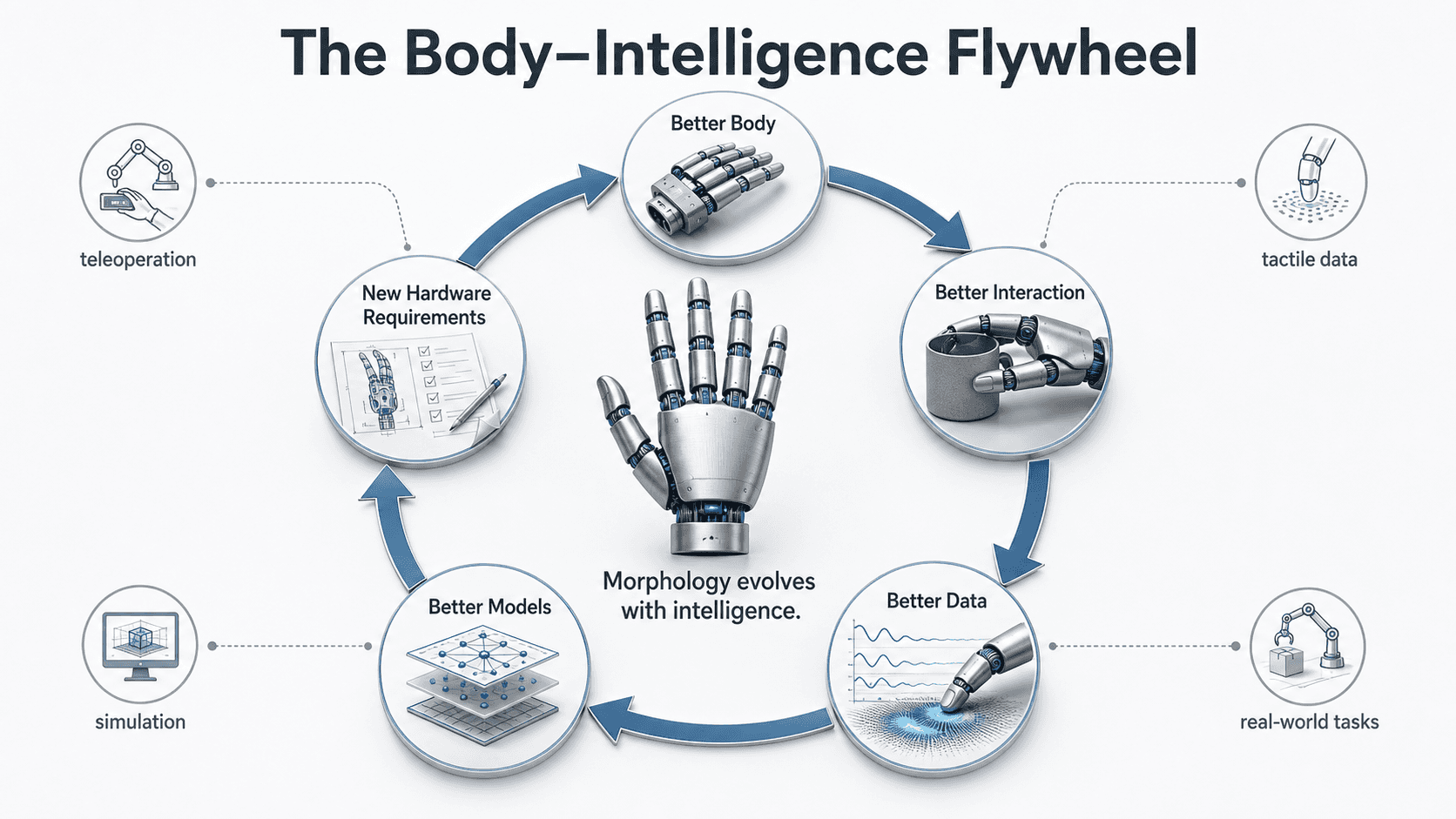
A robotic system is not a static design. It is a continuously evolving loop.
Better morphology can produce:
More stable control trajectories
Higher-quality contact data
More consistent teleoperation data
Broader task distributions
These data, in turn, improve model training.
As models become more capable, they reveal new hardware requirements:
Larger workspaces
Higher force-control bandwidth
Additional degrees of freedom
Greater reliability
This creates a continuous feedback loop:
Morphology → Data → Intelligence → Better Morphology
Over time, the most valuable asset of a robotics company may not be any single generation of hardware.
It may instead be the accumulated understanding of:
How the body should evolve to better serve intelligence.
Morphology Is Intelligence
Traditional robotic systems often treat the mechanical system and the intelligence system as separate domains:
Mechanics execute
Algorithms decide
But in the context of Physical AI, this boundary is beginning to dissolve.
The final capability of a robotic system is jointly determined by:
The structure of its degrees of freedom
Its contact mechanisms
The distribution of sensing
Its force transmission architecture
The way it physically interacts with the environment
Morphology is therefore not merely an external container for intelligence.
It is part of the intelligent system itself.
Morphology defines possibility. Morphology shapes learning. Morphology is intelligence.
The fundamental question is no longer only:
How should AI control a robot?
It is also:
If AI is to enter the physical world, what kind of body should it have?
This is the question Creature continues to explore.
CREATURE JOURNAL